
Seedling benches are essential facilities in modern greenhouse propagation and are widely used for vegetable seedlings, flower seedlings, fruit and melon seedlings, plant propagation bases, agricultural parks, and research greenhouses.
The seedling stage is a very important part of crop production. Young plants have weak root systems and require suitable temperature, humidity, ventilation, drainage, and management conditions. Professional seedling benches keep trays above the ground, reducing the impact of ground moisture, soil contamination, and pests. This creates a cleaner, more organized, and more stable growing environment for seedlings.
Improving Seedling Management Efficiency
Traditional ground-level seedling production is simple, but it may cause inconvenient operation, poor drainage, excessive moisture, and soil contamination. Seedling benches raise the growing area to a comfortable working height, making sowing, watering, fertilizing, thinning, inspection, moving, and grading easier. This helps reduce labor intensity caused by long-term bending.
With an orderly bench layout, the greenhouse area becomes clearer and easier to manage. Seedlings of different varieties, batches, or sowing dates can be placed in separate zones for better recording and management. For large-scale seedling nurseries, this standardized layout improves production efficiency and makes the propagation process more organized.
Seedling benches can also work with sprinkler systems, micro-sprinkler systems, fertigation systems, and greenhouse environmental control systems. Growers can adjust water, fertilizer, temperature, and humidity according to seedling growth stages, helping seedlings grow more uniformly and strongly.
Good Ventilation and Drainage Protect Seedling Roots
Seedling benches often use metal mesh surfaces or permeable bench tops, providing good ventilation and drainage. After watering, excess water can drain away quickly, reducing long-term water accumulation under seedling trays. This helps lower the risk of root rot, weak seedlings, and disease.
Air can circulate under the bench, improving the root zone environment. For plug seedlings, vegetable seedlings, and flower seedlings, healthy roots directly affect transplant survival rate and later growth speed. Good ventilation and drainage support root development and improve seedling quality.
Keeping seedling trays above the ground also reduces the influence of weeds, soil, standing water, and pests. The greenhouse floor becomes easier to clean and disinfect, helping maintain a hygienic propagation environment for the next production cycle.
Stable Structure for Long-Term Greenhouse Use
Greenhouse seedling benches must carry seedling trays, growing media, water, and young plants for long periods, so structural strength and material durability are important. High-quality seedling benches are usually made of galvanized steel, hot-dip galvanized mesh, or anti-corrosion materials. They provide good load-bearing capacity, rust resistance, and corrosion resistance in humid greenhouse environments.
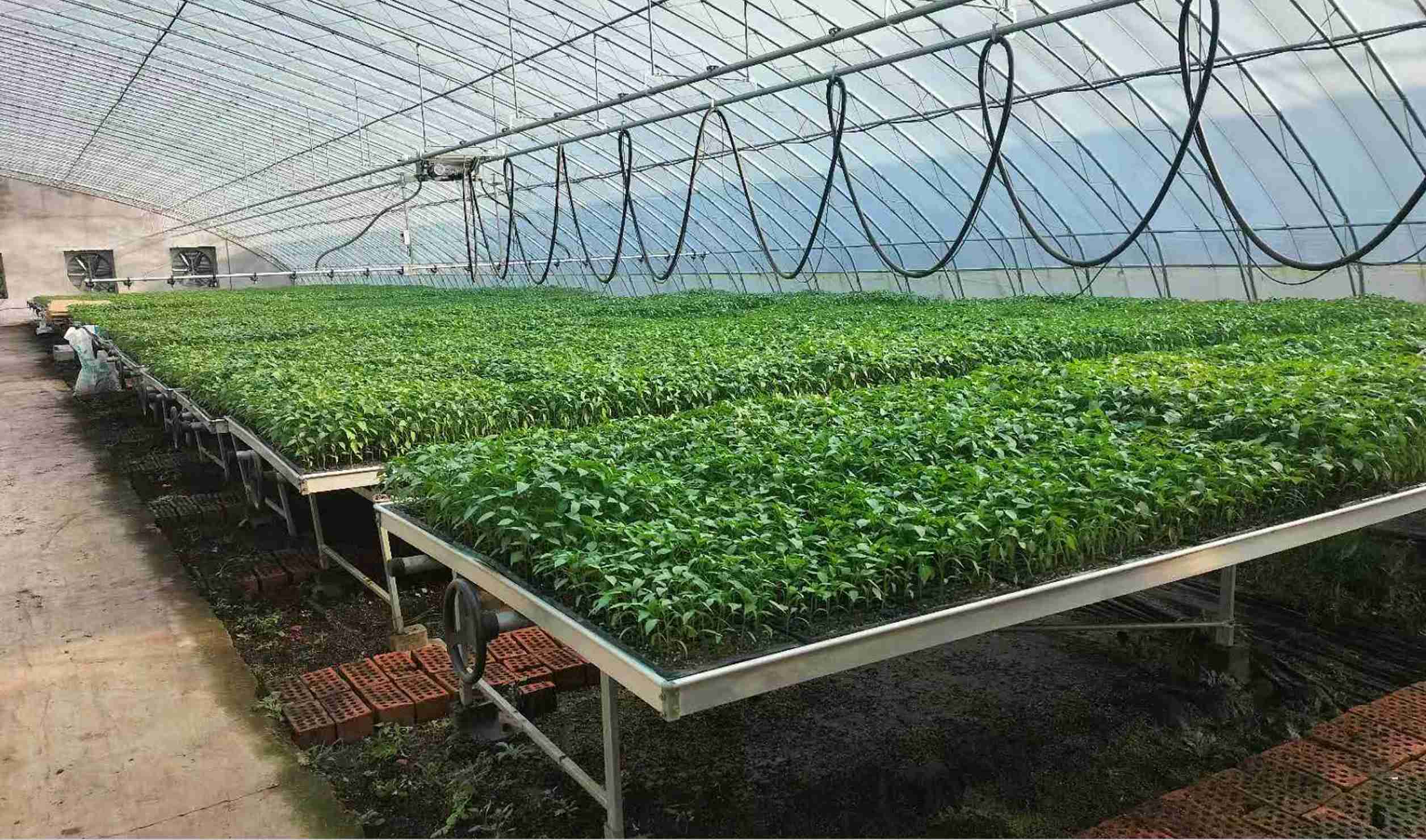
As shown in the image, the benches are installed flat and neatly, with a stable support structure. This strong structure ensures safe daily use and makes later management and maintenance easier.
Bench size, height, mesh specification, and aisle layout can be designed according to greenhouse area, crop type, and customer operation habits. A reasonable bench configuration helps improve greenhouse space utilization while keeping daily work convenient.
Suitable for Many Seedling Production Applications
Seedling benches can be used for many types of propagation, including vegetable plug seedlings such as tomato, cucumber, pepper, eggplant, and lettuce. They are also suitable for flower seedlings, small potted plants, strawberry propagation, melon and fruit seedlings, and agricultural research trials.
For seedling companies, uniformity and survival rate directly affect sales and planting results. Seedling benches provide a stable platform for young plants. When combined with proper temperature and humidity control, water-fertilizer management, and ventilation, they help improve seedling quality.
In modern agricultural parks and seedling factories, seedling benches can also be combined with automatic irrigation, supplemental lighting, shading systems, and intelligent control systems to create a more efficient and standardized propagation model.
Hebei Zhaokuo Provides Professional Seedling Bench Solutions
Hebei Zhaokuo focuses on the production and service of greenhouse bench systems and agricultural facility products. According to greenhouse structure, seedling scale, crop type, and management requirements, we can provide suitable seedling bench design solutions.
We pay attention to structural stability, corrosion resistance, load-bearing capacity, and practical installation performance, helping customers build a more standardized, efficient, and clean propagation space.
Whether it is a new seedling greenhouse or an upgrade of an existing greenhouse, Hebei Zhaokuo can provide practical suggestions based on site dimensions and actual use requirements. By properly planning bench size, aisle width, and area layout, greenhouse space utilization and seedling management efficiency can be improved.
Conclusion
Seedling benches are essential basic facilities in modern greenhouse propagation. They improve the growing environment for young plants, provide good ventilation and drainage, reduce ground contamination and pest risks, and improve labor efficiency and greenhouse space utilization.
For seedling projects that require high survival rate, uniform growth, and large-scale production, choosing a suitable seedling bench system provides a strong foundation for later crop growth.